

|
War Is (Still) Not the Answer by Andrew Foster Connors
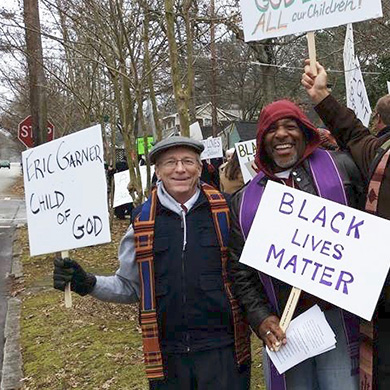
I remember standing on a street corner in March of 2002 with a sign saying simply, “war is not the answer.” It was an interesting group of seven or eight of us, a teacher, a minister, a few retired self-described peace activists, a couple of nuns. A man drove up to the corner rolled his window down and spewed his vitriol. “I wish they’d bomb all of you to hell,” he said and then he spit on the sister standing beside me. A lot has happened since that lonely day in 2002. Groups like that one grew around the country, rejected our exile, until a new movement was born. Partly through our voices, the political climate changed – candidates no longer had to demonstrate their hawkishness, but defend why they voted for an ill-conceived war. One of the few Senators who voted against the war from the beginning is now our President. On election night it was easy to feel as though our work together was done. Peace had won! The war would soon be coming to an end. And then I remembered that many Americans felt this way when Martin Luther King delivered his public condemnation of the war in Vietnam. At the time he spoke, 9,000 Americans had lost their lives in the war. Yet almost 50,000 more would be lost before the last of our troops was safely home. The Vietnam experience points to a central lesson in politics, one that lovers of peace are quick to unlearn: peace requires political will. Political will is generated by the voices of people who come together to speak an alternative to the politics of violence that so often seduces leaders in our nation. In 1932 Franklin D. Roosevelt famously said to a group of reformers, “I agree with you. I want to do it. Now make me do it.” The war in Iraq has already claimed the lives of more than 4200 Americans and somewhere between half a million and 1.2 million Iraqis. Imagine entire population of the city of Baltimore killed over a six year period. Without sustained political pressure to end the war, those numbers will continue to rise. I have heard some express a concern that they wish to give President Obama some time. Others say they trust him to “do the right thing.” These expression of well-wishing are noble, but ill-founded. As a seasoned community organizer, I imagine that President Obama, of all politicians, would be the first to share Roosevelt’s truthful observation and challenge to those who believe they have elected a reformer. Anyone who believes that President Obama wants to “do the right thing” and end the war in Iraq, should support his desire by helping to sustain the political pressure he needs to follow through. The Christian Peace Witness invites you to do just that by joining with us on the 100th day of President Obama’s administration. As we have done in the past, we will gather for worship to hear again God’s peaceful alternative to the way of violence. We will challenge each other to bear that vision publicly, and sustain our voices until the war is indeed ended. Baltimoreans are invited to meet at Penn Station at 4pm, purchase roundtrip MARC tickets ($14), and join in prayer before departing on the 4:50pm train for Union Station. Bring a lunch or buy one on arrival at Union Station. From there we will metro to National City Christian Church where worship featuring Daniel Berrigan, Liz McAllister, Tony Campolo, and Sr. Dianna Ortiz will take place at 7pm, followed by a candlelight procession to the Whitehouse led by Rev. Raphael Warnock of Ebenezer Baptist church. At 9:30 pm the Baltimore delegation will depart in time to catch the 10:30 pm train home. It will be a late night, but an important one, not simply for our movement, but for Americans and Iraqis alike. You are invited to bring a loaf of bread and $1 or more for DirectAid Iraq, an Iraqi humanitarian and peacebuilding effort working with Iraqi refugees. I hope to see you on the train. Last night a coalition of citizens in the Park Heights neighborhood went before Baltimore’s liquor board to raise concerns about four (count ‘em – 4!) liquor stores that are in the 5100 block of Park Heights Avenue. This action reminded me of BUILD’S work in the Oliver Community where a single liquor store has contributed to all kinds of health and safety issues in that neighborhood. One of the things I’ve learned is that some of these establishments are licensed as “taverns” which allows them to extend their hours well past the hours approved for a normal store that sells alcohol. President of the City Council, Stephanie Rawlings-Blake has called for a hearing on April 23. Heber Brown, III, head of young clergy for social change, and a good friend, is part of the effort. Andrew (the pastor) In a recent blog, Marian Wright Edelman asks, “Where are the Children in President Bush’s Budget?“ She goes on to note that almost 13 million children in America live in poverty today, an increase of 1.2 million since the President took office. Bush requests an 11 percent overall increase in military spending for 2009, yet can’t find money in the budget to meet the basic needs of children. I agree with Dr. Edelman that when we fail to feed, clothe, shelter, care for, and educate our children properly, while at the same time giving tax breaks to the wealthy, our priorities are way out of line. On Palm Sunday Jesus rides into the city with a different kind of agenda – one that flips power on his head and defines justice as how well the most vulnerable in our society are cared for. On that day, I invite you to come and hear Marian Wright Edelman share this kind of faith-filled agenda – an agenda that judges our nation by how well our children are cared for. For tickets or directions. . .click here For the past year, I’ve worked with Maryland Citizens Against State Executions (MD CASE) on its campaign to abolish Maryland’s death penalty. I long ago decided that we as a society should not be empowered to execute others. But, having spent a year learning more about the issue, I am now more convinced that it is time to move past capital punishment. It is enormously expensive, makes victims’ loved ones wait an agonizingly long time for justice, and carries the very real risk of executing an innocent person. Last spring, I spent time in Annapolis with a half-dozen men – all of whom were convicted and sentenced to death for crimes they did not commit. All were eventually exonerated. But we must all wonder how many other innocent people have not been spared. Despite many strong arguments for repeal, the issue remains at a political stalemate in Maryland today. Governor O’Malley is a staunch opponent of capital punishment, and while there is strong support for repealing it in the legislature, the right votes are not currently in place. Nationally, many states are also wrestling with this important decision. On Feb. 3rd, Brown will be visited by the state’s leading expert on the death penalty, Jane Henderson, executive director of MD CASE. She is a lively, passionate advocate who will share with us what is happening in Maryland and across the country. Please join us at 10 a.m. in the Church House. Tom Waldron (church member) Comment [1] Prior to Sunday, I knew the Oliver neighborhood of East Baltimore by reputation only. I had read it was one of the most blighted neighborhoods in the city. I had heard Pastor Calvin Keene tell his story of witnessing one of the young men from the neighborhood die on the sidewalk just steps from his church. He was shot a few days after he had gone to visit Pastor Keene to ask for help getting a job. The young man had told Pastor Keene he wanted out of the gang life. And most recently I knew of Oliver through the work BUILD is doing to raise money to build affordable housing in the neighborhood. To me, Oliver was “out there” – I didn’t know anyone who actually lived there, I vaguely knew where it was located – somewhere a little north of Johns Hopkins hospital. It was a place that I could hardly fathom existed. And, if I missed reading the paper one day, or didn’t listen to public radio one morning, or didn’t turn on the news (all three of which frequently occur in my life) I could easily deny it existed. But since Sunday, I can no longer deny Oliver. On Sunday afternoon a fellow BUILD member agreed to give me a tour of her neighborhood. And yes, the blight was as bad as the paper described. There was a crack vial on the sidewalk where I parked my car. And I felt very self conscious as I knocked on her door while the locals walked by. I couldn’t help but wonder what they thought of me. But for all the differences in our neighborhoods, what struck me most that afternoon were the similarities we shared. Before we set out on the tour, she invited me into her home. It was well kept and decorated for Christmas, just like mine. Her son is in high school and she is planning for him to go to college, just as I intend for my children to do. Her son started at one high school, but when he became the victim of school violence, she immediately intervened and arranged for him to be transferred to a different school, just as I would do if my children were at risk. She pointed out the park in the back of her row home. Through a BUILD action, the residents recently got the landlord to repair the broken street lights that had been shot out by drug dealers so they could conduct their business under the cover of darkness. Now that it is light again, the dealers have moved on and the kids can play in the park. She is thankful to have an outdoor space for her son to go because at times she wants him out of the house. I feel the same way at times about my two sons. As we drove through the neighborhood and looked at all the vacant, boarded up and bricked up row homes she asked “Who would want to live here?” That’s just what I was thinking. And as we talked about BUILD, I learned that she too is struggling with figuring out how it “works” and how to engage more people from her church in the organization. There will still be days I don’t read the paper, or listen to the radio, or watch the news. But there will never be a day I don’t think of Oliver. Elizabeth Reichelt (church member) Comment [3] The Cantata on Sunday was pure gift for me. Thank you, John, for your masterful conducting Barbara Cook (choir member) It’s been more than a year since a Brown Memorial Park Avenue member first made that comment. Like many in my generation he was accustomed to getting his information from the Internet. He was looking for a dynamic, social justice-minded congregation, whose people are not afraid to take risks, or enter the public arena to live out their faith. Unfortunately, our website seemed to convey that we were an old church, with beautiful windows, and content that hadn’t changed in several years. The good news was that this member visited a number of other churches with slick looking websites only to discover that their marketing was better than what he found when he got there! Our new website has a new domain name – browndowntown.org – but you already know that. We hope that the change of name will be a symbolic way of conveying to our membership, to our visitors, and to the general public that it is a new day at Brown Memorial Park Avenue. With a cadre of volunteers training themselves more and more each day on how to keep our site updated, we are striving to create a content-rich site that conveys some of the good news that we’re called to share in Baltimore and beyond. Anytime we begin something new, it’s wise to pause and give thanks for what led us here. Specifically I want to thank Matthew Fedderly who developed our original site while he was still in high school. He had the foresight to know that we needed a website before a lot of people even knew what a website was. If our old website was outdated it was only because we didn’t keep up with Matthew to begin with! Also, through the years, a number of members took turns at pushing their pastor onto the web with sermons and articles and calendar updates. These include Willem Errens, Bud Graves, Monica Rakowski, Lisa Eney, Brantley Davis, and Betsy Nix. Andrew (the pastor) Comment [9] |